
Phone: +86 15398058207
E-mail: sales@blisspak.com
Add: Room 603 Building C, The Huixin Center, Zhangba One Road, Yanta Zone, Xi'an City, Shaanxi Province, China
What is blister mold?
The word "blister" originates from Old French blestre (13th–14th century) or Middle Dutch bluyster, meaning a fluid-filled swelling on the skin. Dictionary definitions include: A blister is a small raised area on the skin caused by friction or burns, or a bubble-like raised defect on the surface of metal or glass. As a verb, blister refers to the act of causing bubbles or blisters to appear, and also means to criticize harshly or severely. The term commonly refers to pathological skin conditions or raised, bubble-like structures on material surfaces. In the packaging and thermoforming industry, “blister” adopts the meaning of a raised bubble-like structure. It refers to a plastic product formed by heating plastic sheets and shaping them into raised cavities using vacuum forming or pressure forming processes.This structure is widely used in packaging to hold, protect, or display products.
Blister and Thermoforming: What Is the Difference?
Blister refers to a type of packaging, while thermoforming is a manufacturing process used to produce plastic parts, including blister packaging. The two terms are closely related but represent different concepts in plastic packaging and forming.
Blister packaging describes a packaging solution in which a transparent plastic cavity is formed to hold and display a product. The plastic blister is typically sealed to paperboard, aluminum foil, or another plastic substrate to provide product protection, visibility, and tamper resistance. In this context, the term blister focuses on the final packaging form and its function rather than the method used to create it. Thermoforming, on the other hand, is a plastic forming process in which a thermoplastic sheet is heated until it becomes pliable and then shaped over or into a mold using vacuum pressure, air pressure, or a combination of both. After forming, the plastic is cooled and trimmed to produce the final part. Thermoforming is widely used across industries such as packaging, medical devices, automotive components, and industrial applications, and it describes how a plastic product is manufactured. Blister packaging is most commonly produced using the thermoforming process, as thermoforming allows precise control over cavity shape, thickness distribution, and surface detail. However, not all thermoformed products are blister packaging. For example, medical trays, industrial inserts, and automotive interior panels may be thermoformed but are not considered blisters because they do not serve a packaging function.
A common misunderstanding is to treat blister and thermoforming as interchangeable terms. In reality, blister is the application or end result, while thermoforming is the process that makes it possible. In the same way, a blister mold is not a separate type of tooling from a thermoforming mold, but rather a specific type of thermoforming mold designed to create blister cavities.In summary, blister packaging is a packaging solution, and thermoforming is the process used to manufacture it. Understanding this distinction helps avoid confusion in technical communication, product descriptions, and customer discussions.
How many types of molds are used in thermoforming process?
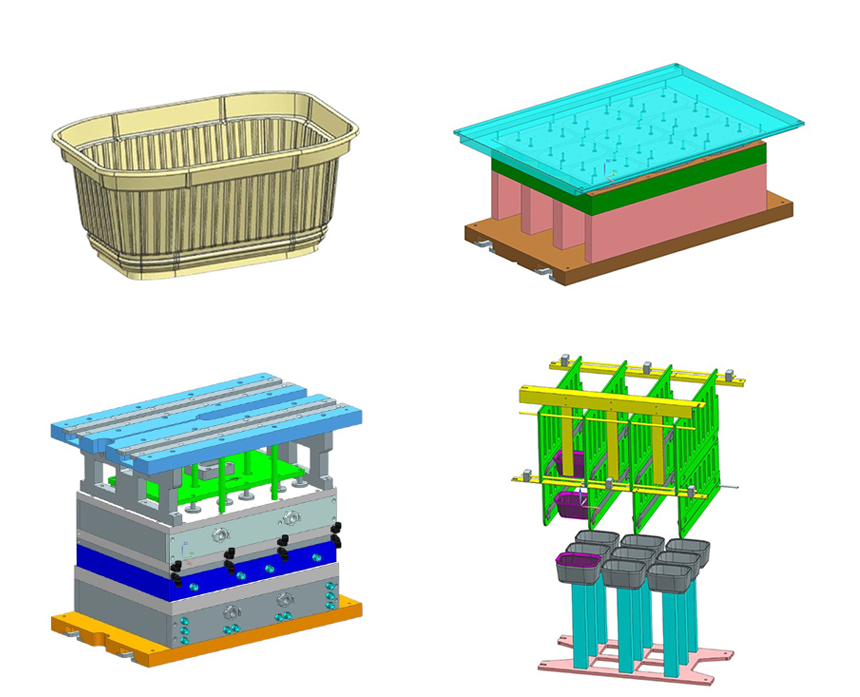
In a complete thermoforming or blister packaging process, multiple types of molds are used to perform different production steps, from plastic forming to cutting and final stacking. Each mold plays a specific functional role in the production line, and each presents its own level of technical complexity. Understanding the function and technical difficulty of these molds helps customers better evaluate product quality, tooling cost, and overall production efficiency.
Forming Mold: The forming mold, also known as the blister mold, is the most critical mold in the thermoforming process. Its primary function is to shape heated thermoplastic sheets into the desired cavity geometry of the final product. After heating, the plastic sheet is formed over or into the mold using vacuum pressure, air pressure, or a combination of both, allowing the material to conform precisely to the mold surface.This mold directly determines the product’s appearance, dimensional accuracy, and forming consistency, which makes it the most technically demanding mold in the entire process. During design and manufacturing, factors such as draft angles, wall thickness distribution, vent hole layout, material shrinkage, and demolding performance must be carefully considered. In addition, mold material selection, commonly aluminum or copper alloys, and machining accuracy significantly affect forming efficiency, surface quality, and mold service life.
Punching Mold: The punching mold is used to separate the formed thermoformed parts from the plastic sheet after the forming process is completed. This step defines the final outer shape of the product and ensures clean and consistent edges. The key function of the punching mold is to achieve precise cutting with minimal deformation or burrs. Its technical challenges mainly lie in blade design, cutting clearance control, and wear resistance. For products with complex contours, tight tolerances, or thicker plastic materials, the punching mold requires higher design accuracy and more durable tooling materials, which increases manufacturing difficulty and cost.
Cutting Mold: The cutting mold is typically applied for secondary trimming or localized cutting operations when higher dimensional accuracy or special structural features are required. Compared to standard punching molds, cutting molds focus more on detailed edge refinement and localized precision. The technical difficulty of cutting molds lies in accurate positioning, stable cutting structures, and repeatability during high-volume production. Improper design may lead to material distortion, uneven edges, or inconsistent product dimensions. For premium packaging applications, cutting molds play an important role in improving overall product quality and visual appearance.
Stacking Mold: The stacking mold is used after forming and cutting to automatically stack thermoformed products in an orderly and stable manner. Its primary function is to align and stack individual parts for downstream packaging, handling, and transportation. Although stacking molds do not directly participate in the forming process, they have a significant impact on production efficiency and labor cost. The main technical challenges involve stacking angle control, stack height consistency, and adaptability to different product geometries. For thin-walled, flexible, or irregularly shaped products, stacking mold design often requires extensive testing and optimization to ensure stable automatic stacking.
The Importance of Mold Integration in Thermoforming: In practical production, forming molds, punching molds, cutting molds, and stacking molds do not operate independently but function as a complete and integrated tooling system. Any weakness in mold design, precision, or alignment at one stage can negatively affect product appearance, dimensional stability, and production efficiency. Therefore, high-quality thermoforming production depends not only on the performance of individual molds but also on the coordinated design and precision matching of the entire mold system.
Our Advantages in Thermoforming and Blister Mold Manufacturing
In the highly competitive thermoforming and blister packaging industry, tooling quality directly determines product consistency, production efficiency, and long-term operating cost. With years of hands-on manufacturing experience, we focus on delivering reliable, high-performance molds that meet the real demands of mass production. Our advantages are built on engineering expertise, manufacturing precision, and a deep understanding of customer applications.
Our advantage begins at the design stage. We develop thermoforming and blister molds based on a thorough understanding of product structure, material behavior, and production conditions. During mold design, key factors such as draft angles, wall thickness distribution, venting layout, shrinkage control, and demolding performance are carefully analyzed to ensure stable forming and consistent quality. By optimizing mold structures at the early stage, we help customers reduce forming defects, improve yield rates, and achieve smoother downstream operations.
We use precision CNC machining and strict dimensional control to ensure mold accuracy and repeatability. Critical forming surfaces and cutting areas are carefully processed to achieve smooth finishes and tight tolerances, which directly affect product appearance and edge quality. Our quality control process covers every stage of mold manufacturing, from raw material inspection to final assembly and testing. This ensures that each mold delivered is ready for production and performs consistently under long-term operation.
We have extensive experience across a wide range of thermoforming applications, including consumer packaging, medical trays, industrial inserts, and custom blister packaging. This experience allows us to quickly identify potential production challenges and provide practical, production-oriented solutions rather than purely theoretical designs. By understanding real production environments, we design molds that are not only accurate but also easy to operate, maintain, and integrate into existing production lines.
Unlike suppliers that focus on a single tooling stage, we provide integrated mold solutions covering forming molds, punching molds, cutting molds, and stacking molds. This system-level approach ensures precise matching between different molds and minimizes alignment issues, dimensional deviation, and handling inefficiencies.
An integrated tooling solution helps customers achieve smoother production flow, higher automation levels, and lower overall operating costs.
Our molds are designed with production efficiency in mind. Optimized heat transfer, proper venting, and stable structures contribute to shorter cycle times and reduced scrap rates. At the same time, we balance performance with cost by selecting suitable materials and machining methods based on production volume and application requirements.This approach allows customers to achieve long-term cost savings rather than just short-term tooling investment reduction.
We believe that effective communication is a key part of successful tooling projects. From initial inquiry to mold delivery, we maintain clear and professional communication, providing technical feedback, design suggestions, and production insights whenever necessary.Our goal is not only to supply molds, but also to help customers improve product quality, production stability, and market competitiveness.


- Disposable sushi tray with lid wholesale
- Custom Disposable Plastic Cups with Logo
- Is blister packaging cheap?
- How to Make Your Own Blister Packaging?
- Advantages of Wine Vacuum Trays
- Custom Packaging Solutions for Precious Metal
- Why choose BlissPak for vacuum forming services?
- What Are The Five Modern Packaging Materials
- Why Bamboo Food Containers Are Better Than Plastic
- The Benefits of Bamboo Fiber Material Food Packaging